Table of Contents
- When the Train Is the Right Answer
- When Buses and Marshrutkas Work
- Bike Days
- Driver Service
- Where a Rental Car Fills the Gaps
- A Balanced 10-Day Shape
- Planning Rules
- When Not to Rent a Car
- When to Reserve Early
- Example Mixed Day
- FSTA Route Support
TL;DR: Mix trains, buses, bikes, drivers, and short car rentals by route, with coastal ideas, Baku to Tbilisi planning, and practical day-trip choices.
Overview
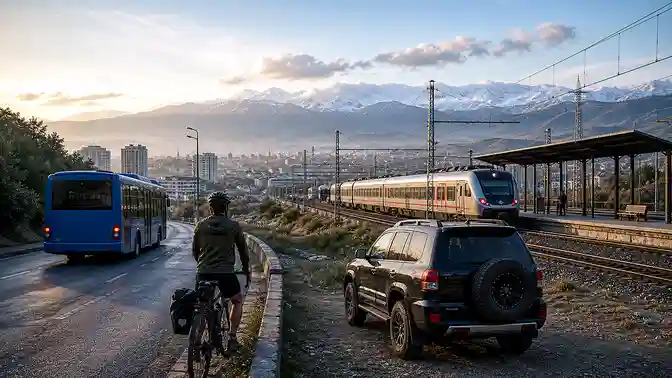
Not every Caucasus trip needs a car every day. Some of the best travel days use trains, buses, bikes, ferries, walking, taxis, or driver service, then save the rental car for the roads where flexibility really matters. The smartest itineraries mix tools.
Use slower transport when it improves the day, and use a car when luggage, children, remote stops, early starts, or mountain roads make public transport awkward.
When the Train Is the Right Answer
Trains are useful for city-to-city links where roads are tiring and stations are convenient. In Georgia, rail can work well for Tbilisi, Kutaisi, Batumi, Zugdidi, and some regional links. The relaunched Tbilisi-Baku train also gives travelers a cleaner way to connect Georgia and Azerbaijan without driving every kilometre.
When Buses and Marshrutkas Work
Minibuses and coaches are cheap and frequent on major routes, but comfort varies. They are best for simple point-to-point travel with light luggage. They are weaker for monasteries, vineyards, villages, and multi-stop days.
Bike Days
Short bike routes can turn a coast or river corridor into a highlight. Around Batumi, the Gonio, Kvariati, and Sarpi direction can work by bike or city bus in good weather, with traffic awareness. Do not treat every scenic road as bike-friendly; check shoulders, tunnels, and driver behaviour first.
Driver Service
A driver is useful when the route involves wine tasting, border logistics, rough roads you do not want to handle, or a one-way transfer. It costs more than a bus but can save a day from becoming a puzzle.
Where a Rental Car Fills the Gaps
Use a car for Kakheti villages, Vardzia and Samtskhe-Javakheti, Racha, Svaneti access, Armenian monasteries, Gobustan, Lahic, Sheki, or any route where the best stops are between towns. A car is especially helpful when traveling with family or gear.
A Balanced 10-Day Shape
One good structure is: walk and use taxis in the capital, rent a car for three to five countryside days, take a train for a long city-to-city transfer, then finish with another walkable base. This feels calmer than driving everything.
Planning Rules
Do not mix too many modes in one day. Build buffer time around stations. Keep luggage realistic. Check current schedules close to departure, especially for international rail.
When Not to Rent a Car
Skip the car for dense city days, wine-tasting days without a designated driver, and routes where parking is worse than the attraction. In Tbilisi, Yerevan, Baku, Istanbul, and central Batumi, walking plus taxis or transit often wins.
When to Reserve Early
Reserve cars early for July and August mountain travel, winter ski weekends, and any route needing a true 4x4. Reserve trains as soon as tickets open for international routes or holiday periods. Flexibility is lovely, but popular transport can still sell out.
Example Mixed Day
A good mixed day might be train from Tbilisi to Kutaisi, taxi to a hotel, then rental car the next morning for canyons and villages. Another might be Batumi city bus to Gonio, bike along the coast, then taxi back after dinner. The point is to solve each segment with the tool that fits.
FSTA Route Support
FSTA can help mix self-drive, driver service, and non-car transport into one practical plan, especially when a route crosses Georgia, Armenia, Turkey, or Azerbaijan.